
Aloe Ferox drinks in Nigeria: how to compare them properly
17 August 2026 · 5 min read
Several bottles on the Nigerian market are built on the same South African plant. Here is what actually separates one from another, and the five checks worth making before you pay.
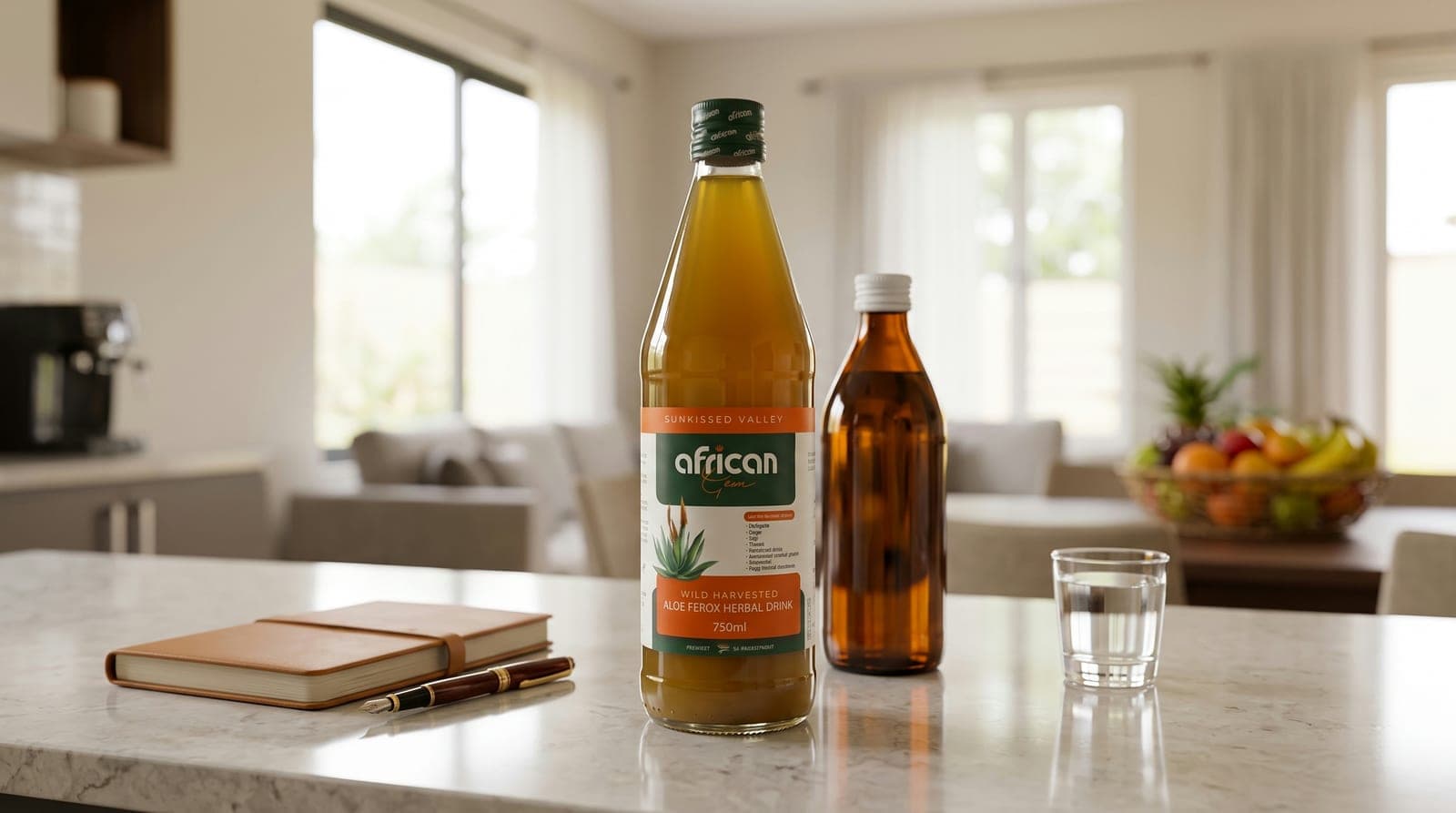
If you have gone looking for an Aloe Ferox drink in Nigeria, you have met the same situation everyone does. Several bottles, several names, several distributors, and very little that tells you how one differs from another. Jigsimur is the name most people know first. African Gem is another. There are more.
They have genuinely more in common than the marketing suggests. Most are built on Aloe ferox, the bitter Cape aloe that grows wild in the Western Cape of South Africa and has been harvested there for centuries. Most are bottled in South Africa and imported. Most are registered with NAFDAC. If someone tells you the plant in their bottle is a different plant, they are usually describing the same species.
So the useful question is not "which brand is best". It is "what am I actually comparing". Five things genuinely differ, and four of them are printed on the bottle.
1. What else is in it besides aloe
This is the real difference, and it is the one most people never check.
Some Aloe Ferox drinks are close to single-botanical preparations: aloe, water, an acidity regulator, a preservative. Others are formulated blends where aloe is the base and several other plants are built on top of it.
African Gem is in the second group. Alongside the Aloe Ferox there are five more Southern African and European botanicals: Sutherlandia, known locally as kankerbos and one of the region's best-known traditional plants; African Potato; Wild Olive leaf; Wild Dagga, a flowering shrub of the Southern African veld; and St. John's Wort, the European herb with centuries of traditional use behind it.
Neither approach is automatically better. A simpler preparation is easier to understand and easier to verify. A blend gives you more constituents for the same bottle. What matters is that you know which one you are buying — and that the label tells you, in full, without hiding behind "proprietary blend".
The check: read the constituent list. If a product will not tell you everything in it, that is information too.
2. Volume, and the number nobody prints
Aloe Ferox drinks in Nigeria are commonly sold in 750ml and 250ml bottles, and the prices are quoted per bottle. That makes comparison harder than it should be, because a cheaper bottle is often a smaller one.
Work out the cost per millilitre. It takes ten seconds and it is the only figure that makes two prices comparable:
- Divide the price by the millilitres.
- Do it for both bottles.
- Compare those two numbers, not the shelf prices.
A 750ml bottle at ₦15,500 costs about ₦20.70 per millilitre. A 250ml bottle at ₦7,000 costs ₦28. The second bottle looks cheaper and is not.
The check: price divided by millilitres, always.
3. NAFDAC registration, and how to verify it
Any herbal preparation sold legitimately in Nigeria should carry a NAFDAC registration number. Most of the established Aloe Ferox drinks have one. Jigsimur has one. African Gem's is A7-102608L, printed on the bottle and displayed on our product page.
The number itself is not the point. The point is that you can check it. NAFDAC maintains a searchable database of registered products, and a number that does not resolve — or a bottle with no number at all — tells you something a brochure never will.
This matters more in this category than in most, because Aloe Ferox drinks are widely counterfeited. A registration number on the carton and a batch code on the bottle are the two things a counterfeiter finds hardest to reproduce convincingly.
The check: find the number, then check the number. Do this for whichever brand you choose, including ours.
4. Where the plant actually came from
Aloe Ferox is not farmed at scale the way Aloe Vera is. It is wild-harvested from natural stands in the Cape, mostly by hand, largely by people whose families have done it for generations. That is why the export trade in bitter aloe from the Cape dates to 1716 and why the plant has never really been domesticated.
Products that are vague about origin are sometimes vague for a reason. A drink built on Aloe Ferox should be able to say where the plant was harvested and where the bottle was filled. If a brand tells you neither, you are being asked to take the most important part on trust.
The check: ask where it was harvested and where it was bottled. Both answers should exist.
5. Who is selling it to you, and whether they will still be there
This is the one that catches people out.
Most Aloe Ferox drinks in Nigeria are sold through distributor networks rather than through shops. That is a perfectly normal way to sell this kind of product, and it has a real advantage: you usually get a person rather than a call centre. It also has a failure mode. If your distributor stops distributing, your supply stops with them, and the WhatsApp number on the flyer goes quiet.
Buying from someone with a real address, a working order system and a way to look up what you bought is not a small thing when you intend to reorder every month.
The check: can you find their address, and can you reach them somewhere other than one phone number?
What this adds up to
Nobody choosing between these products is choosing between different plants. They are choosing between different formulations of the same plant, at different volumes, from sellers of varying permanence.
That is a much easier decision than the marketing makes it look. Read the constituents. Divide the price by the millilitres. Check the registration number against NAFDAC's database. Ask where the plant came from. Find out who you are actually buying from.
Do that and the comparison mostly makes itself — whichever bottle you end up with.
If you want the detail on ours: the African Gem Aloe Ferox Herbal Drink is 750ml, six botanicals, wild-harvested in the Cape and bottled in South Africa, NAFDAC A7-102608L, ₦15,500 delivered anywhere in Nigeria. The constituents are listed in full on the page, which is rather the point of this article.
For the difference between Aloe Ferox and the aloe most people already know, see Aloe Ferox vs Aloe Vera. For the wider checklist that applies to any herbal product, not just this category, see how to choose a herbal drink in Nigeria.