Is African Gem legitimate? A straight answer to a fair question
18 August 2026 · 6 min read
People ask whether this is a pyramid scheme before they ask anything else. That is a sensible thing to check, so here is the honest answer and the five tests you can run yourself.
If someone has shown you this business, there is a good chance the first thing you did was search whether it is a scam. That is the right instinct. Nigeria has seen enough collapsed schemes that scepticism here is not cynicism, it is basic care.
So this article does not open by reassuring you. It sets out what the question actually means, what separates a product-distribution business from a scheme, and the checks you can run on any company that asks for your money. Then it applies those checks to this one, in public, including where the answer is less comfortable.
What people are actually asking
"Is it a pyramid scheme" is usually shorthand for something more specific: will I be asked to pay money in, and then only get it back by finding other people to pay money in?
That is the correct thing to be afraid of. In a pyramid arrangement the money comes from recruitment. There is no product, or the product is a token that exists to make the payment look like a purchase. Because the only source of income is new entrants, the arrangement has to collapse: the number of people needed to keep it paying doubles at every level, and eventually there are not enough people.
Nigeria's SEC has issued repeated public warnings about exactly this structure, and they are worth reading before you join anything, this included.
The distinction that matters is not whether a company has levels or bonuses. Plenty of ordinary businesses pay commission down a chain. The distinction is where the money comes from. If it comes from people buying and consuming something they would want anyway, the business can sustain itself. If it comes from entry fees, it cannot.
The test that separates the two
Ask this: if recruitment stopped completely tomorrow, would there still be income?
In a product business the answer is yes. People who like the product keep reordering, and whoever sold it to them keeps earning on those reorders. Growth slows, but nothing collapses.
In a scheme the answer is no. Stop the recruiting and the income stops the same week, because recruiting was the income.
You can usually tell which you are looking at within a few minutes:
- Is there a real product, at a price a stranger would pay? Not a membership, not a course about the business itself. Something someone outside the network would buy on its own merits.
- Do people outside the network actually buy it? A product only distributors buy is not a product. It is an entry fee with packaging.
- Can you earn without recruiting anyone? If the only route to income is a downline, that answers the question.
- Is it priced like a product? Compare it to similar things on the open market. A wildly inflated price is how an entry fee disguises itself.
- Can you return unsold stock? Companies confident in their product take it back. Schemes need the inventory to stay with you.
How African Gem answers those checks
Same order, and you should verify each of these rather than take our word for it.
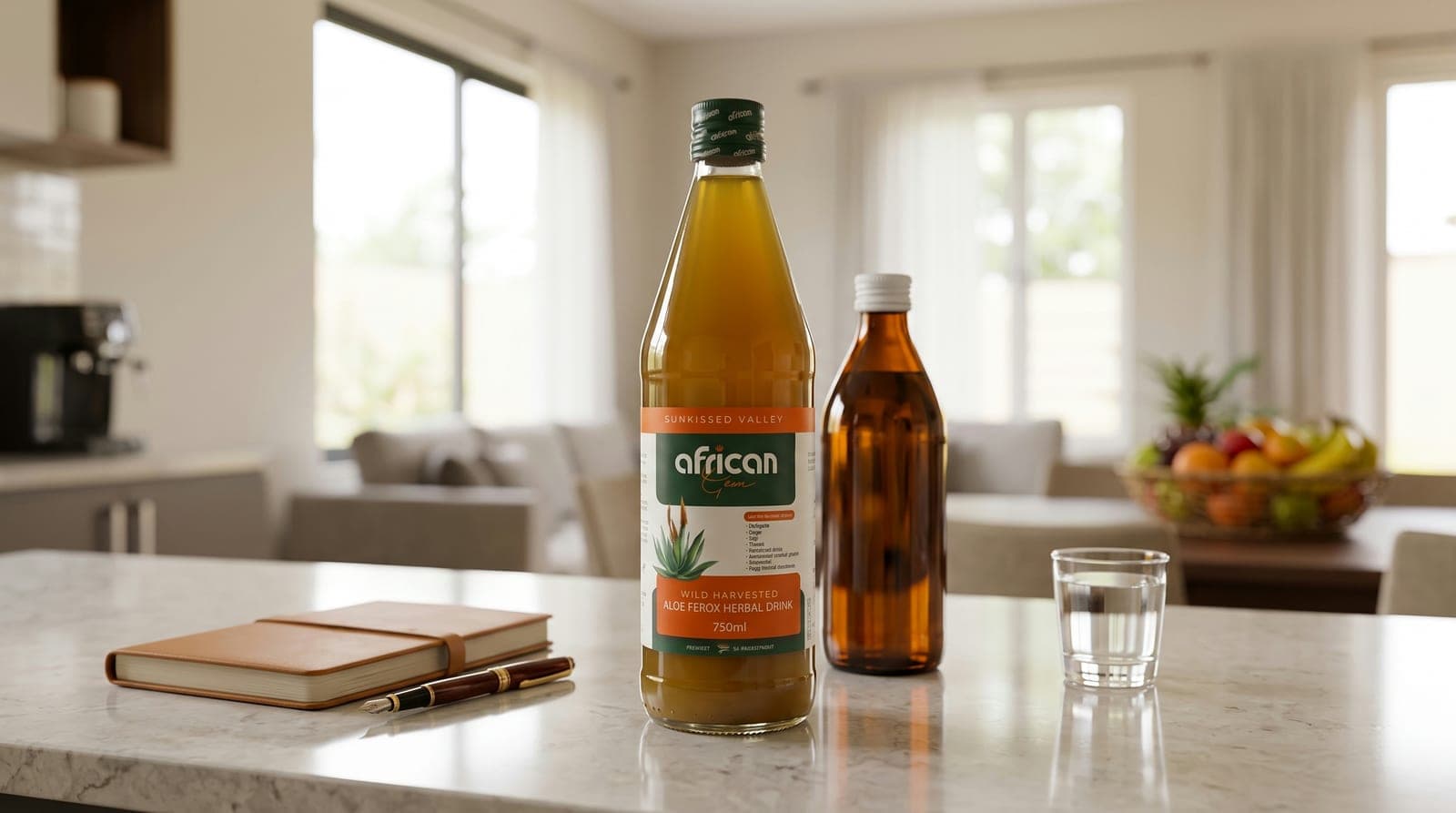
There is a product. The African Gem Aloe Ferox Herbal Drink is a 750ml bottle of Southern African botanicals at ₦15,500, registered with NAFDAC under A7-102608L — a number you can check against NAFDAC's own database. It is sold in shops and on marketplaces by people with no connection to us.
Retail customers buy it. Most people who drink it are not distributors and never will be. You can buy a single bottle from this site without joining anything, and most people do exactly that.
You can earn from retail alone. Buying at distributor price and selling at retail is the first of the published earning methods and involves no downline at all. The others exist and are set out in full on the compensation plan, but the first one stands on its own.
The price is a market price. Comparable Aloe Ferox drinks in Nigeria sit in a similar range, which you can confirm in two minutes on any marketplace. There is a whole piece here on how to compare them properly.
The terms are published. Distributor terms are on the site rather than in a private document, so you can read them before you pay rather than after.
Earnings depend entirely on your own effort, skill and time — no income is guaranteed. This is a product-distribution opportunity, not an employment offer or investment.
What we will not tell you, and why
Here is the part most pages leave out.
We do not publish what distributors earn. Not averages, not examples, not "one of our people made this last month". You will not find a figure like that anywhere on this site, and if someone shows you one on WhatsApp, it did not come from us.
That is deliberate, and it deserves explaining rather than being left to look like evasion. Income examples are the most misleading thing a business like this can publish. A real figure from a real person is still unrepresentative, because people who earn well are by definition not typical, and printing their number invites you to picture it as yours. Regulators class unrepresentative income claims as deceptive for exactly that reason, and they are right to.
So what is published is the structure: the rates, the qualifying conditions, the point values, the rank thresholds. That is the machinery, stated plainly. What comes out of it depends on what you put in, and nobody can honestly tell you that number in advance.
If a company shows you projected earnings before it shows you the product, you have learned something important about that company.
The honest limitations
A few things a fair article has to say.
This is selling, and selling is work. Nobody hands you customers. If you do not enjoy talking to people about something you use, this will not suit you, however the plan is structured.
Your upline matters more than the company. The plan is identical for everyone. The difference between a good experience and a bad one is usually whether the person who registered you is still answering their phone three months later.
Start small. The smallest package exists so you can test whether this suits you before committing money you would miss. Anyone pushing you straight to a large package is optimising for their own bonus rather than your outcome.
Nothing here is investment advice, and this is not an investment. You are buying stock to sell.
Where to check for yourself
Do not finish this and take it as settled. An article on our own site is not evidence. Do these instead:
- Look up A7-102608L in NAFDAC's product database.
- Search the product on Jumia and Jiji and see what unrelated sellers charge.
- Read the compensation plan in full, including the qualifying conditions rather than only the rates.
- Ask whoever introduced you what they actually earned, and notice whether they answer plainly or change the subject.
- Buy one bottle before you buy a package. If you would not reorder it yourself, you have no business selling it.
If you get through all that and still want to start, the distributorship page sets out the packages and what registration involves. If you do not, the drink is available on its own and always will be.