
Aloe Ferox vs Aloe Vera: what actually makes Cape Aloe different
10 August 2026 · 6 min read
Not a variety, not a grade, not another name for the same plant. Two species, two harvests, two traditions, and an honest answer to which one is better.
Most people have met one aloe. It is the short, soft, pale green plant on a windowsill, the one you snap open for the clear gel inside, the one printed on the side of every second bottle in the skincare aisle. That is Aloe Vera, and it is genuinely useful.
Aloe Ferox is a different plant. Not a variety, not a grade, not a marketing name for the same thing. A separate species, growing in a different place, harvested a different way, and valued in its tradition for a different part of the leaf.
If you are choosing between them, or you have seen Aloe Ferox on a label and want to know whether the distinction is real, this is the honest comparison.
They are two species, not two names
Both belong to the genus Aloe, which is why the confusion exists. Beyond that they diverge.
Aloe Vera is the world's commercial aloe. It grows low and clumping, forms offsets around its base, tolerates cultivation well, and is farmed at scale across the Americas, Asia and the Mediterranean. Its commercial value sits in the clear inner-leaf gel, which is filleted out and processed into juice, drinks and skincare.
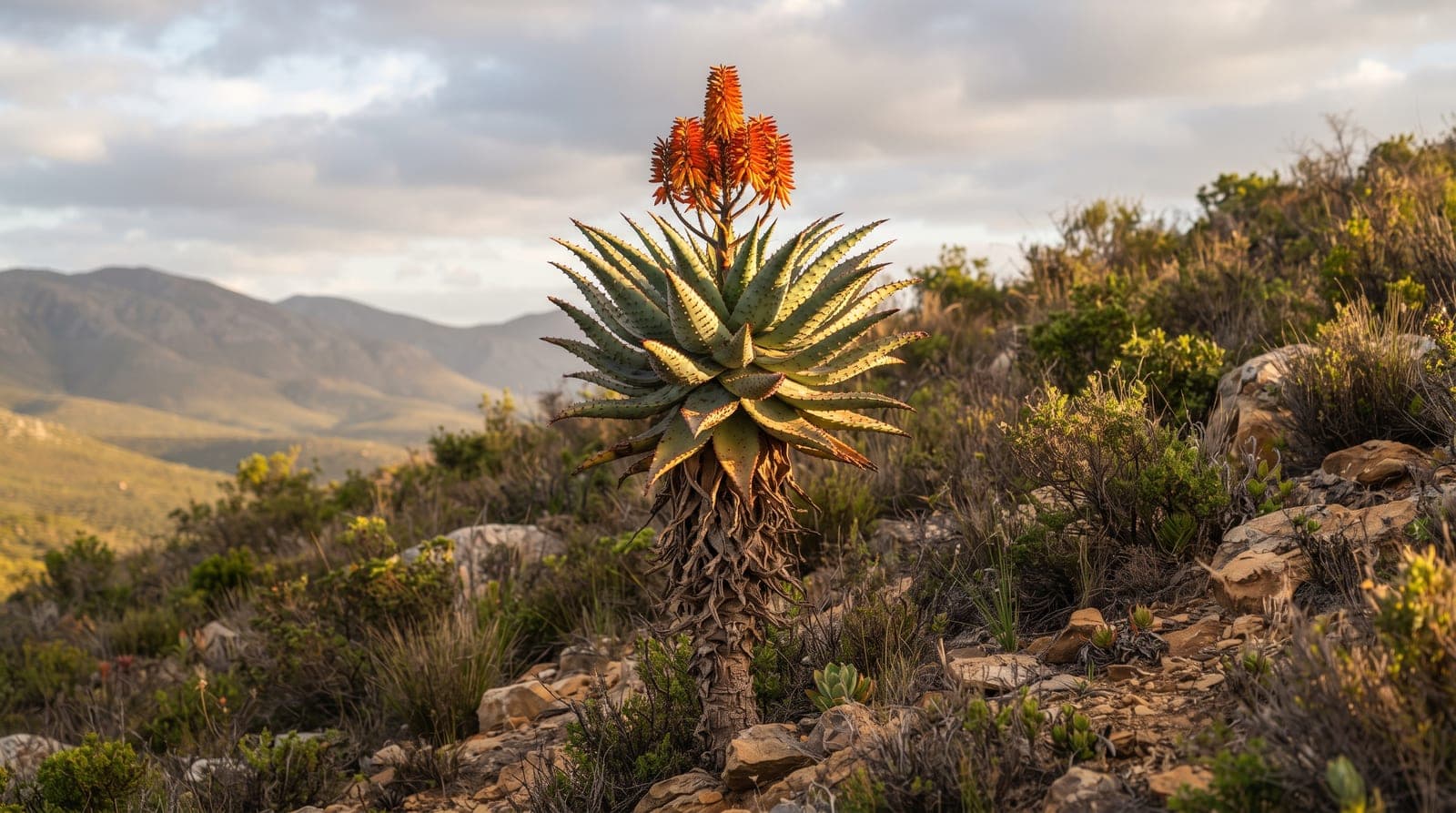
Aloe Ferox, the Cape Aloe or bitter aloe, is native to Southern Africa and grows there in the wild. It is a tall plant on a single woody stem, carrying a crown of thick, spined, blue-green leaves well above the ground, standing in dry rocky country in the Cape. It does not clump and it does not spread quickly, which is part of why it is gathered rather than farmed.
The everyday test is height. If it sits on a table, it is Aloe Vera. If you have to reach up to cut it, you are looking at Aloe Ferox.
The harvest is the real difference
This is the part most comparisons skip, and it is where the character of the plant comes from.
Aloe Vera is a crop. It is planted in rows, irrigated, cut on a cycle, and processed in volume. That is not a criticism; it is what makes Aloe Vera affordable and consistent worldwide.
Aloe Ferox is largely gathered from wild stands by hand. Harvesters work through open country, cut a portion of the outer leaves from a mature plant, and leave the plant standing to grow on. The same plant is returned to in later seasons. There is no field, no row, no irrigation line, and no way to hurry it.
That method carries a cost and a consequence. The cost is that supply is limited by how much wild plant exists and how far people are willing to walk. The consequence is that what ends up in the bottle came from a plant that grew on its own terms, in poor soil, under real sun, over years.
You can read the wild-harvest story in more detail, including how Cape aloe became an export from the Cape from 1716 onwards, and its far older place in Khoisan plant tradition.
Bitter, and unapologetic about it
Cut an Aloe Ferox leaf and two things come out of it.
The first is a bitter amber sap that drains from the cut edge. This is the fraction the plant is traditionally known for, dried into the substance long traded as Cape aloes, and it is the reason the plant is called bitter aloe.
The second is the inner leaf, which yields a milder gel closer to what people expect from Aloe Vera.
Aloe Vera's commercial story is almost entirely the second one. The bitter fraction is generally removed, because the market for Aloe Vera wants something mild. Aloe Ferox's tradition runs the other way: the bitterness is the point, and a preparation that does not taste of anything is not what the tradition was making.
That matters practically. A Cape Aloe drink is meant to taste bitter. If you are expecting something sweet, you will be surprised the first time. Most people find that after a week or so the taste stops registering as unpleasant and starts registering as familiar, in the way strong coffee does.
So is Aloe Ferox better?
That question has a real answer and it is less exciting than either side would like.
They are suited to different jobs. Aloe Vera is mild, gel-forward, widely available and well suited to skincare and to gentle drinks. Aloe Ferox is bitter-forward, wild-harvested, less abundant, and belongs to a tradition of daily tonics rather than gentle refreshment.
African Gem formulates its drink from Aloe Ferox on the stated basis that the species carries a naturally higher concentration of active plant compounds than common Aloe Vera. That is the producer's position and the reason the species was chosen. What we will not do is put a number on it that we cannot stand behind, or tell you that one plant does something to your body that another does not. Anyone quoting you a precise multiplier without a source is guessing, and the rest of what they tell you deserves the same suspicion.
What Aloe Ferox is used for
Within wellness terms, and within what may lawfully be said about a herbal supplement in Nigeria, Aloe Ferox is used as a daily bitter tonic. The African Gem Aloe Ferox Herbal Drink describes its role as follows:
- Supports a healthy immune system
- Supports natural energy levels and vitality
- Supports healthy digestion and regularity
- Supports the body's natural cleansing processes
- Supports joint comfort, flexibility and mobility
- Supports relaxation and restful sleep
- Traditionally taken as a bitter digestive tonic
Each of those describes support for a normal function. None of them describes an effect on any disease, and that is not a technicality of wording. It is the limit of what is known and the limit of what any responsible seller of a herbal supplement should be willing to say to you.
What else is in the bottle
Aloe Ferox is the base, not the whole recipe. The drink blends it with five other Southern African and European botanicals, each carrying its own long tradition of use:
- Aloe Ferox (Cape Aloe). Wild-harvested in South Africa; a bitter tonic since the time of the Khoisan, exported from the Cape since 1716.
- St. John's Wort. A European herb with centuries of traditional use in wellness preparations.
- Wild Olive. Leaf of the African wild olive, long used in Southern African herbal tradition.
- African Potato. A Southern African plant traditionally taken as a general wellness tonic.
- Sutherlandia. Known locally as kankerbos, one of Southern Africa's best-known traditional botanicals.
- Wild Dagga. A flowering Southern African shrub with a long history in traditional preparations.
St. John's Wort is worth flagging specifically. It is well documented as interacting with a number of prescription medicines, which is a good reason to speak to your pharmacist before starting this or any botanical blend if you take anything regularly.
How to choose between them
Ask three questions of any aloe product, whichever species it names.
Which species is on the label, written in full. Where was it grown or gathered, and does the seller say. What exactly is claimed, and does the claim stay inside supporting normal function.
A product that answers all three plainly is telling you it has nothing to hide. How to judge a herbal drink before you buy it works through the rest of the checklist. If your interest in aloe started with feeling heavy after meals, start there instead.
Browse our herbal drinks.